Resources
See it explained in a few minutes.
Short clips on how cities put smart lighting control to work, straight from the engineers who build it. Each one opens on YouTube.
Resources

Grand Rapids, Michigan, to Install New Smart Streetlights
Originally aired on WoodTV8 in July 2023: Grand Rapids is upgrading its LED streetlights with more than 18,000 Dimonoff smart lighting nodes, giving the city cloud-based remote control over every fixture. "Smart lighting nodes literally sit on top of regular LED streetlights... you see all the little dots, which are streetlights and streetlight controllers," says Bernard Têtu, Dimonoff’s founding president.
Watch on YouTube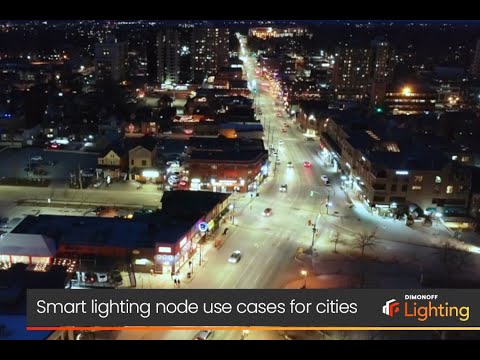
Smart Lighting Node Use Cases for Cities
The RME wireless lighting node does more than control and monitor streetlights: it can flash a beacon at the address a 911 call came from, help mark an evacuation zone during a gas leak, and carry readings from other sensors — river levels, sewer levels, parking occupancy — over the same network.
Watch on YouTube
A Future-Proof Connected Lighting Node
Built on new electronics, radios and a FreeRTOS-based operating system, the RME is designed to connect not just today’s digital and analog sensors but future ones too — and to update its firmware, its radio’s firmware and its security layers entirely over the air.
Watch on YouTube
Exhibiting at Lightfair 2022 in Las Vegas
At the Lightfair International trade show, Dimonoff exhibited its street lighting control and parking management systems, alongside a new product built with Siemens: CitySafe, a wireless audio/visual mass notification system that pairs colour-coded emergency beacons with smart street lighting.
Watch on YouTube
Smart Lighting Node Combined With IoT Platform
Pairing the RME lighting node with Dimonoff | SCMS turns the lighting network into a general IoT platform: consumption, maintenance alerts and readings from river, sewer and parking sensors all land on one map, ready for analytics or a third-party system.
Watch on YouTube
Enhanced Smart Wireless Lighting Node
After twelve years of development, the third-generation RME adds radios for both short- and long-range communication at a lower communication cost, and covers 110 to 480 volts, 50/60 Hz, with a single product.
Watch on YouTube
Adding Control to Street Lights
Converting from HPS to LED is the moment to add wireless control: the RME lets a city dim individual fixtures that citizens find too bright, and meters and monitors every light so outages get caught before anyone has to call in.
Watch on YouTube
Bright Future for Cities
A wireless communication network thirty feet up on every streetlight pole becomes one shared network for lighting status, environmental sensors (air and water quality) and security detection (accidents, gunshots, flooding) — all in service of more attractive, more financially efficient cities.
Watch on YouTube
Want to see it running on your own streets?
Tell us about your lighting network and we will walk you through a live demo.